
When overseas buyers compare quotations for custom kitchen cabinets, two kitchens that look identical in a rendering can be priced very differently. Most of the gap is hidden inside the doors: the board used for the carcass, the material and finish of the doors, the edge banding and the hardware. This guide explains the three engineered boards you will meet most often, what each is good and bad at, and which questions to ask before you approve a quotation.
It is written from our point of view as a custom cabinetry maker in Lecong, Foshan, but the questions apply to any supplier.
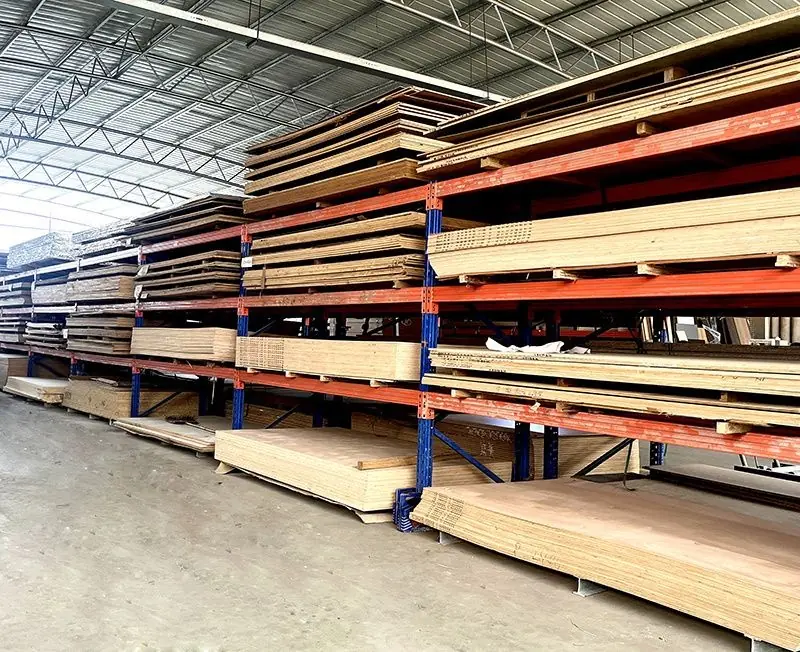
The three boards in plain words
Plywood is made from thin wood veneers glued together with the grain of each layer crossing the one below. That cross-lamination makes it stable and stiff for its weight, and screws hold well in it, including near the edges. The quality depends heavily on the core veneers and the glue, so two "plywood" quotes are not automatically equal. In China you will often hear it called multi-layer board (多层板).
MDF (medium-density fibreboard) is made from fine wood fibres pressed with resin into a dense, uniform sheet. Its surface is very smooth and it can be routed into profiles, which is why it is a common base for painted and lacquered doors. It is heavy, and screws hold less well in its edges than in plywood. Raw MDF swells if water reaches an unsealed edge.
Particle board (chipboard) is made from larger wood particles bonded with resin. It is flat and economical, and is very often supplied with a melamine surface already applied. Like MDF, it is vulnerable at exposed or damaged edges, and it is less forgiving if a cabinet is assembled, taken apart and reassembled.
None of these is "bad". Each is a trade-off between stability, weight, surface quality, moisture behaviour and price, and each is only as good as its grade and the way it is edged and assembled.
Where each material tends to be used
| Part of the kitchen | What matters most | Common choices |
|---|---|---|
| Carcass (cabinet box) | Stiffness, screw holding, moisture near sinks and dishwashers | Plywood or moisture-resistant particle board |
| Painted or lacquered doors | Smooth, stable surface for paint; routed profiles | MDF |
| Melamine or laminate doors | Flat surface, economy | Particle board or MDF with a factory-applied surface |
| Shelves | Resistance to sagging over the span | Plywood, or thicker board with a shorter span |
| Sink base | Water resistance | Plywood or moisture-resistant board, fully edge-banded |
Our own direction over the years has been away from MDF and particle board carcasses towards plywood carcasses and newer door materials. Miu Wong, our General Manager, describes this change in a client interview we published, Why Overseas Buyers Keep Coming Back. The board, finish and hardware for each order are still confirmed project by project in the quotation and production drawings, because the right choice depends on the design, the climate and the budget.
Formaldehyde: know which standard is being quoted
Engineered boards are bonded with resins, and buyers rightly ask about formaldehyde emissions. The difficulty is that each market uses its own test method and labels, so a number only means something together with the standard it was tested to.
- China, GB/T 39600-2021, classifies wood-based panels as E1, E0 or ENF, with ENF the strictest class.
- Japan, JIS, uses star ratings, with F☆☆☆☆ the top grade.
- The United States regulates composite wood under TSCA Title VI (based on the earlier California CARB rules).
- Europe has long used the E1 class, with some countries applying stricter national rules.
On our material test reports page we publish the reports our board suppliers obtained. They include a plywood rated ENF under GB/T 39600-2021 (0.020 mg/m³ against a limit of 0.025, SGS-CSTC Guangzhou, 2025), a particle board sample rated F☆☆☆☆ under JIS A 5908:2022 (SGS-CSTC Guangzhou, 2025), and an E0 plywood under GB/T 39600-2021 (Foshan Supervision Testing Center, 2023). These are suppliers' material reports for the samples tested. They are not company certifications, and they do not replace a document check for your own order.
Practical tip: if your market has a legal requirement, say so in the enquiry. Then ask the supplier which board will be used and which report covers it, before you pay the deposit.
Doors, finishes and edges
The carcass sets how long a kitchen lasts. The doors and edges set how it looks after a few years.
- Painted / lacquered doors need a stable, smooth substrate and a good finishing system. Our published reports include PU primer and PU matt clear finish from our coating supplier, tested to EU RoHS.
- Edge banding is the first line of defence against moisture. Ask whether all edges, including hidden back and bottom edges near the sink, are banded.
- Adhesive matters too. A water-based adhesive report from our supplier (Henkel, HJ 2541-2016) is on the same page.
Hardware is part of the material decision
Drawer runners and hinges get the hardest use in a kitchen. Ask which brand and series is quoted, and whether that is the same hardware shown in the sample. We publish a Blum TANDEM drawer runner report (QB/T 2454-2013, SGS-CSTC Anji) obtained through the supplier. Where you want a specific hardware brand, name it in your brief so it is priced from the start.
Climate and use: questions to ask yourself
- Is the climate humid, or will the kitchen be closed up for long periods (holiday homes, villas)? Pay more attention to edge sealing and the sink area.
- Will the cabinets ever be moved or reassembled? Plywood tolerates this better.
- Painted doors or textured laminates? The door finish often decides the door board.
- Long open shelves? Ask about thickness and span.
Checklist before you approve a quotation
- Carcass board type, thickness and grade
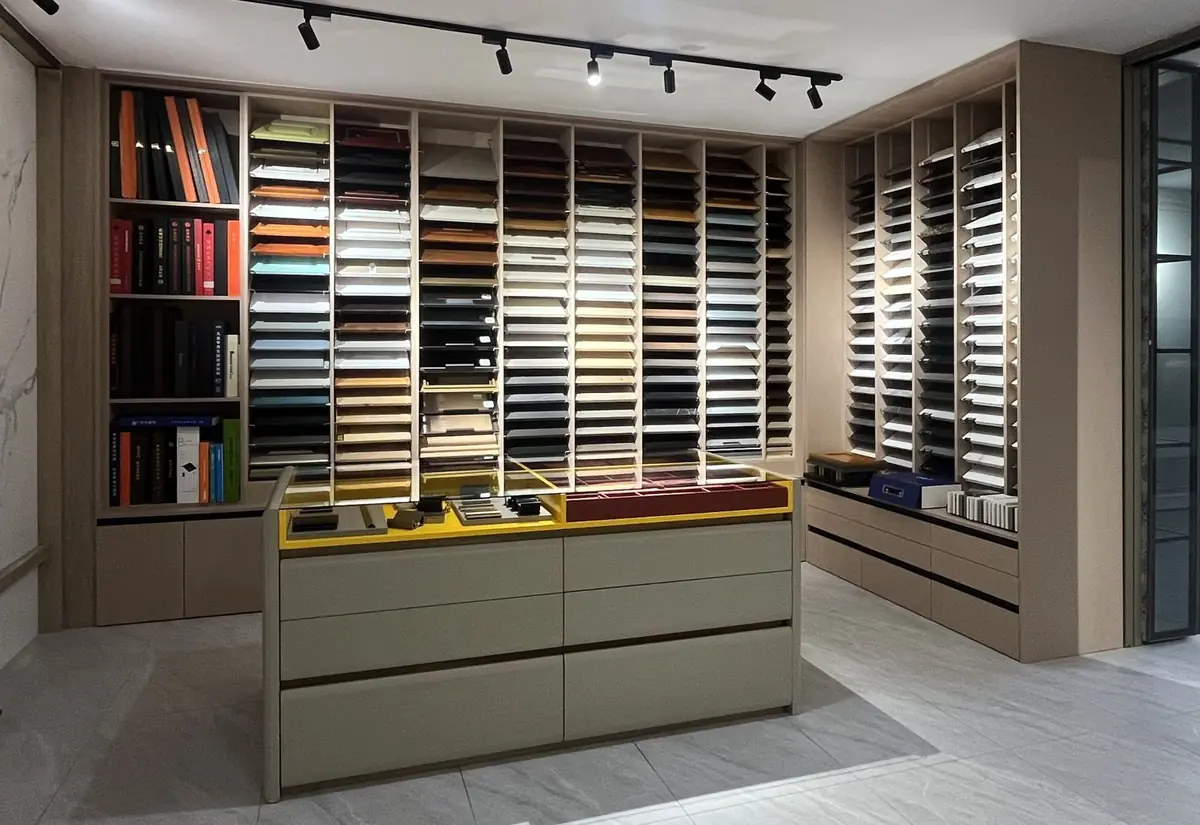
- Door board and finish system, with a physical sample
- Edge banding on all edges, including hidden ones
- Formaldehyde class and the standard behind it
- Hardware brand and series for runners and hinges
- Worktop material (for example quartz stone; we publish a quartz stone report too)
- Packing method for export
Frequently asked questions
Which board does Anna Collection use for kitchen cabinets?
Board, finish, hardware and packing specifications are confirmed for each project in the quotation and production drawings. Over the years we have moved away from MDF and particle board towards plywood carcasses and newer door materials, and supplier test reports for the boards we publish are on our material test reports page.
Is MDF a poor material for cabinets?
No. MDF has a very smooth, uniform surface and is a common base for painted and routed doors. Its weak points are weight, screw holding at the edges and swelling if water reaches an unsealed edge, so good edge sealing matters.
Are your test reports company certifications?
No. Most reports on our test reports page were obtained by our material suppliers for the samples they tested. They are not certifications of Foshan Xuzhihui Household Products Co., Ltd.
Is there a minimum order for a custom kitchen?
There is no minimum order quantity for custom orders. Samples take about 15 days and delivery takes 30 to 60 days depending on the order.
Planning a kitchen?
See our OEM custom kitchen cabinets page, or read how to prepare drawings in How to Measure and Brief a Custom Kitchen for a Factory Abroad. If you are also buying appliances, lighting or sanitary ware from other factories, our sister company XZH Trading can source and inspect them and ship them in the same container.
Anna Collection (Foshan Xuzhihui Household Products Co., Ltd.)
Email: xzhfurniture@outlook.com · WhatsApp: +86 150 9988 5586 · xzhfurniture.com
Showroom in Lecong, Foshan, by appointment.